


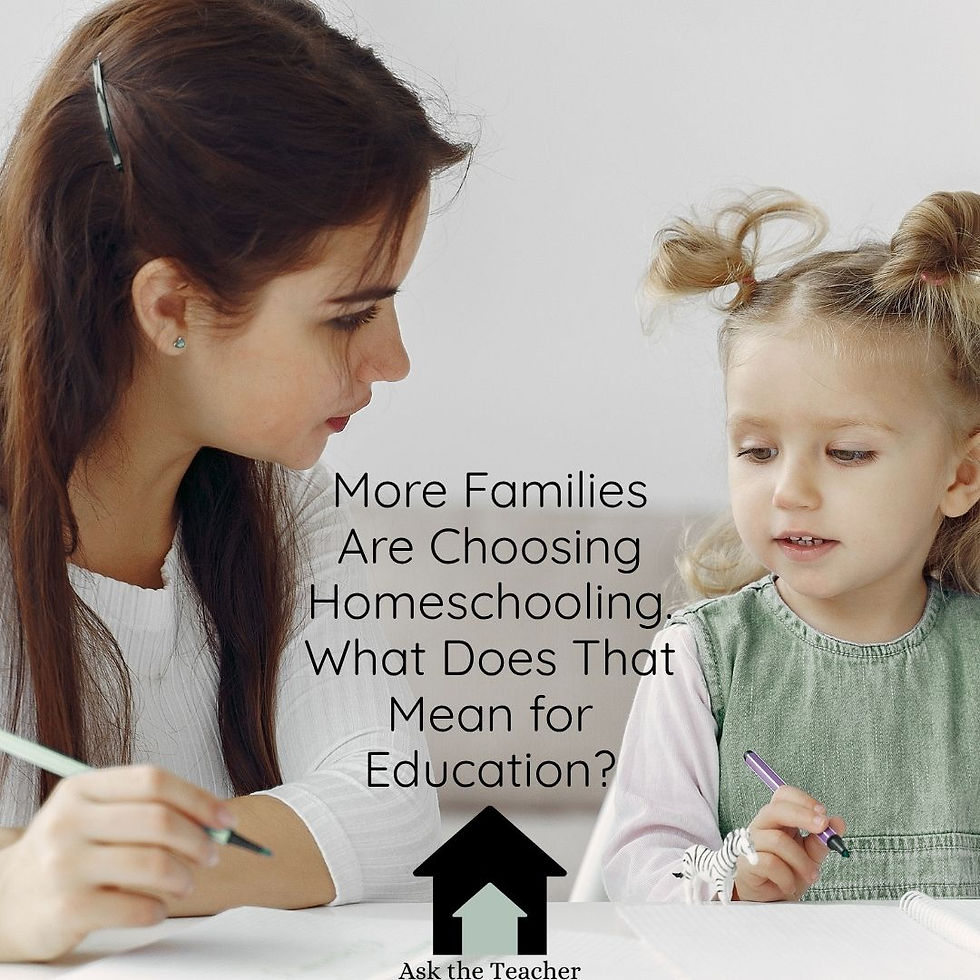
More Families Are Choosing Homeschooling. What Does That Mean for Education?

If you've been paying attention to education news over the last few years, you've probably noticed a growing trend: more families are choosing to homeschool their children.
Recent data suggests that homeschooling remains significantly more popular than it was before 2020. Millions of students are now being educated primarily through homeschooling. Researchers at Johns Hopkins University and other organizations have found that homeschooling continues to grow even after the pandemic, suggesting that for many families it has become a long-term educational choice rather than a temporary solution.
For some people, that trend is exciting. For others, it raises questions. But regardless of where you stand, there is one thing worth remembering:
Most parents and teachers want the same thing.
They want children to learn.
They want children to feel safe.
They want children to grow, discover new interests, build friendships, and develop the skills they need for life.
The setting may look different, but the goal is often the same.
The Education Landscape is Changing
Not long ago, conversations about education often focused on two choices: public school or private school.
Today, many families have additional options. Some children attend traditional public schools, some attend private schools, some are homeschooled. Some participate in hybrid programs, micro schools, co-ops, virtual learning programs, or combinations of several approaches.
For many families, the decision comes down to what works best for their child at a particular time.
And what works for one student may not work for another.
Teachers Are Teachers
One thing that sometimes gets lost in discussions about schooling options is how much work educators do, regardless of where they teach.
Classroom teachers spend countless hours planning lessons, supporting students, grading work, communicating with families, and creating learning experiences.
Homeschooling parents often spend hours researching curriculum, teaching lessons, organizing schedules, and helping children navigate challenges.
Neither role is easy. Both require patience, flexibility, and a willingness to keep learning.
Whether instruction happens in a classroom with twenty students or around a kitchen table with two, teaching is meaningful work.
We Can Learn From One Another
Instead of viewing different educational settings as competitors, there may be opportunities to learn from one another.
Classroom teachers often have tremendous expertise in instruction, classroom management, and curriculum design.
Homeschooling families often develop creative approaches to individualized learning and flexible scheduling.
Parents and teachers can share ideas, resources, and encouragement regardless of where students are learning. After all, a great science activity is still a great science activity. A great book recommendation is still a great book recommendation. A great strategy for helping a struggling reader can help a child in any learning environment.
Small Ways to Support One Another
If you're a classroom teacher:
Welcome respectful conversations with homeschooling families.
Share resources when appropriate.
Celebrate the success of children, wherever they learn.
If you're a homeschooling parent:
Recognize the challenges classroom teachers face every day.
Share ideas and resources generously.
Encourage your children to appreciate the work educators do.
If you're both a parent and an educator:
Offer grace.
Assume positive intentions.
Remember that everyone is trying to help children succeed.
The Focus That Matters Most
Education conversations can sometimes become debates, but children benefit most when the adults in their lives work together.
Whether learning happens in a public school, private school, homeschool, co-op, micro school, or somewhere in between, students need caring adults who support their growth.
The recent growth in homeschooling is one sign that families are exploring a wider range of educational options than ever before.
The most important question may not be where a child learns. It may be whether that child has people who are committed to helping them learn.
And, thankfully, there are a lot of teachers, parents, and caregivers doing exactly that every day.
Sources & Further Reading
Johns Hopkins University Homeschool Hub Homeschool Growth: 2024–2025
National Center for Education Statistics (NCES)


Comments